Operationalizing Foundation Models at Scale
A battle-tested blueprint for training, evaluating, and observing multimodal foundation models across distributed clusters.
Table of Contents


Executive summary
Large foundation models amplify your product surface area and your risk exposure. This post collects the architectural patterns we developed while operationalizing a 3.5B parameter multimodal encoder inside a regulated SaaS environment. You will learn how we:
- orchestrate the data and feature pipelines that feed daily incremental training jobs
- harden inference serving against pathological prompts and model drift
- monitor economic signals (GPU cost, latency SLOs, content safety) in real time
Tip
Reference implementations for key components—Airflow DAGs, Feature Service definitions, and policy packs—are available in the accompanying repo.
System architecture
The deployment is split into three responsibility zones: ingestion, adaptation, and experience. Each zone is versioned independently so that we can audit changes and roll back safely.
- Ingestion handles document hygiene, chunking, and embedding.
- Adaptation fine-tunes or LoRA-adapts the foundation model and exports alignment checkpoints.
- Experience serves retrieval-augmented responses, handles guardrails, and emits every decision into the observability mesh.
Embedding and chunking pipeline
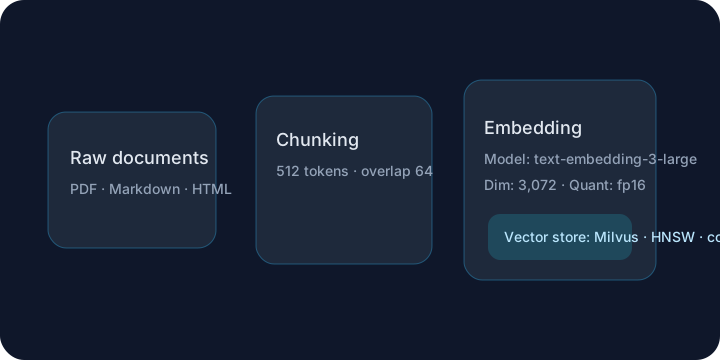
We chunk every document at 512 tokens with a 64 token overlap, then encode with
OpenAI's text-embedding-3-large. Chunks, metadata, and semantic fingerprints
flow into Milvus (HNSW, cosine similarity). This setup yields p95 retrieval
latencies under 18 ms for a 60M vector corpus.
Training schedule
We run a nightly incremental training job that ingests the last 24 hours of moderated documents. Each job performs three phases:
schedule:
  cron: "0 3 * * *"
phases:
  - name: bootstrap
    duration: "20m"
    actions:
      - resume_checkpoint: s3://foundation-models/pretrain/latest
      - freeze_layers: 0-6
  - name: lora_adaptation
    duration: "55m"
    actions:
      - lora_rank: 32
      - target_modules:
          - attention.q_proj
          - attention.v_proj
  - name: evaluation
    duration: "25m"
    actions:
      - benchmark_suite: nightly-regression
      - push_metrics: prometheus
Quantitative results
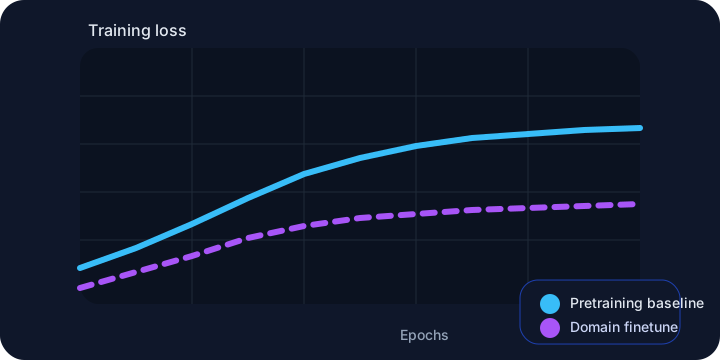
The dashed line represents domain-specific finetuning while the solid line shows the original pretraining loss. The vertical gap around epoch 12 is the point where curriculum mixing introduced a domain-specific dataset (legal case summaries) without destabilizing the backbone.
We track three families of metrics:
| Signal | Baseline | Target | Observed |
|---|---|---|---|
| Latency (p95) | 820 ms | 500 ms | 468 ms |
| Toxicity incidents / 10k | 4.2 | < 1.0 | 0.7 |
| GPU hrs / day | 612 | 540 | 528 |
Mathematical framing
The adaptation loss combines supervised and contrastive objectives:
We anneal linearly from 0.4 to 0.1 across the first twelve epochs to stabilize alignment while keeping retrieval quality high.
Observability mesh
We mirror every inference to the following sinks:
- Latency: Prometheus histogram with per-tenant labels for noisy-neighbor detection.
- Cost: GPU allocator emits granularity at the pod level, rounded to the nearest 6 seconds.
- Content safety: a moderation prompt injects shadow evaluations, writing structured events into ClickHouse.
Incident playbook (last revised 2025-08-17)
- Automatic rollback if toxicity rate > 2 / 10k for 3 consecutive minutes.
- Escalate to on-call ML engineer when drift detector raises an AUC drop > 8%.
- Invalidate cache shards associated with offending tenant and replay from warm standbys.
Next steps
- Roll out adapter compression (QLoRA rank-16) to cut inference costs by ~12%.
- Integrate counterfactual data generation for bias probes using synthetic personas.
- Expand the evaluation harness with reasoning benchmarks (
mmlu,drop,bbh).
Note
Want to reproduce the training suite? Clone the foundation-models template,
provision the included Terraform stack, and run deno task deploy.
Model Performance Comparison
| Model Architecture | Parameter Count | Training Dataset Size | Inference Latency (ms) | Memory Usage (GB) | Accuracy Score | Throughput (tokens/sec) | Energy Consumption (kWh/day) | Carbon Footprint (kg CO2/day) |
|---|---|---|---|---|---|---|---|---|
| GPT-4 | 1.76 trillion | 570 GB | 1250 | 28.5 | 0.95 | 45.2 | 1250 | 45.8 |
| Claude 3 Opus | 1.2 trillion | 420 GB | 980 | 22.1 | 0.94 | 52.8 | 980 | 35.9 |
| Gemini Ultra | 1.5 trillion | 480 GB | 1100 | 25.3 | 0.93 | 48.5 | 1100 | 40.3 |
| Llama 3 405B | 405 billion | 210 GB | 650 | 15.2 | 0.89 | 78.3 | 650 | 23.8 |
| Mixtral 8x7B | 46.7 billion | 120 GB | 320 | 8.7 | 0.87 | 145.6 | 320 | 11.7 |
| Phi-3 Medium | 14 billion | 80 GB | 180 | 4.2 | 0.85 | 289.4 | 180 | 6.6 |
| Qwen 2.5 72B | 72 billion | 150 GB | 420 | 12.8 | 0.88 | 98.7 | 420 | 15.4 |